
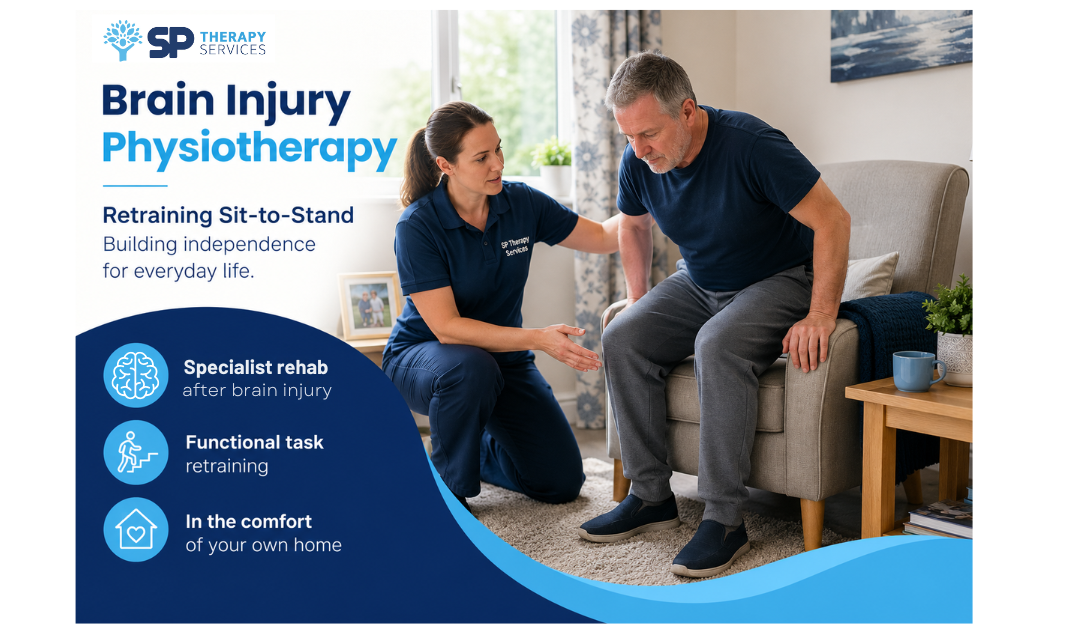
The seemingly simple act of standing up from a chair is one of the most important movements in everyday life. However, for individuals recovering from a brain injury, this task can become a complex challenge that requires careful retraining. Through specialist brain injury physiotherapy, functional tasks such as sit-to-stand can be broken down, adapted, and rebuilt. This process helps patients regain confidence and develop greater independence in daily life.
Brain Injury Physiotherapy and the Art of Task Analysis
A normal sit-to-stand movement involves a precise sequence of actions. These include:
- Positioning the feet correctly
- Leaning the trunk forwards
- Shifting weight appropriately
- Generating momentum
- Extending through the legs in a controlled way
Each stage requires coordination between multiple muscle groups, accurate timing, and effective balance responses.
After a brain injury, any part of this sequence can be disrupted. As a result, a movement that was once automatic may become difficult and require significant concentration.
Specialist physiotherapists are skilled at identifying which components of the movement are affected. For example, is the difficulty caused by the initial forward weight shift? Is it due to delayed leg muscle activation? Or is balance control the main issue during the transition?
Detailed movement analysis allows physiotherapists to provide targeted interventions rather than relying on generic strengthening exercises.
Adaptive Strategies in Brain Injury Rehabilitation
One of the strengths of brain injury rehabilitation is recognising that there are often several ways to achieve the same functional outcome.
For sit-to-stand, adaptations may involve modifying the technique itself. This could include:
- Teaching patients how to use their arms more effectively
- Adjusting foot positioning
- Changing the sequence of movements to compensate for specific difficulties
Equipment adaptations can also make previously impossible tasks achievable.
For example, raising the height of a chair reduces both the distance that needs to be travelled and the strength required to stand. Similarly, firm cushions can improve support during weight transfer, while strategically placed grab rails can provide additional security.
The aim is always to select the minimum adaptation needed to achieve success. This helps preserve dignity while continuing to promote recovery and independence.
Supporting Families During Physiotherapy After Brain Injury
Family members and carers play an important role in functional task retraining.
Through education and guidance, they learn not only what to do, but also when to assist and when to step back.
For sit-to-stand training, this may involve:
- Understanding how to position themselves safely
- Supporting without taking over the movement
- Recognising when verbal cues are helpful
- Knowing how to gradually reduce assistance as the patient improves
Family training goes beyond the physical task itself. It also includes understanding the patient’s cognitive demands, fatigue levels, and emotional responses to both success and perceived failure.
Sit-to-Stand as a Foundation for Brain Injury Rehabilitation
Sit-to-stand is the foundation for many other everyday activities.
Mastering this movement helps develop the strength, balance, and coordination needed for:
- Toilet transfers
- Getting in and out of a car
- Moving from bed to chair
- Progressing towards more complex tasks such as stair climbing
The skills learned during sit-to-stand training can also transfer directly to other activities.
For example, the forward weight shift required to stand is essential for initiating walking. Likewise, the balance control developed during the transition phase supports activities that involve reaching or bending.
The Home Advantage in Brain Injury Physiotherapy
Providing physiotherapy in the patient’s own home offers significant advantages for functional task retraining.
Every home environment is unique. The height of a favourite armchair, the softness of sofa cushions, and the angle of dining chairs can all influence movement performance.
By training with the patient’s own furniture, physiotherapists can ensure that new skills transfer immediately into daily life. This removes the need for additional adaptation when moving from clinical equipment to the home environment.
The patient’s own chair becomes a valuable rehabilitation tool.
For example, physiotherapists may:
- Add a firm cushion to a preferred seat
- Increase chair height using furniture risers
- Position a familiar side table to provide hand support
This approach allows patients to remain in familiar surroundings while addressing their functional needs effectively.
The Lasting Impact of Brain Injury Physiotherapy
When patients master adapted versions of fundamental movements, their confidence often grows alongside their physical abilities.
Success with sit-to-stand frequently marks an important milestone in rehabilitation. It demonstrates that independence is achievable and that the brain can learn new ways to complete essential tasks.
Our specialist team understands that brain injury physiotherapy is both an art and a science. It requires clinical expertise, creativity, and a deep understanding of each individual’s unique challenges and potential.
Ready to Start Your Rehabilitation Journey?
We provide home visits across Greater Manchester, Lancashire, West Yorkshire and South Yorkshire.
Our specialist physiotherapists are based in:
Contact Us to find out how we can support your rehabilitation journey.
Are You a Case Manager Looking for a Physiotherapist to Join Your MDT?
Having been established for more than 27 years, we are trusted by case managers and solicitors alike.
We are proud of our clinical reputation for excellence. In addition, we have an in-depth understanding of the medicolegal landscape.
To ensure you remain fully informed, we provide timely three-monthly treatment plans, together with SMART goals and detailed costings.
Contact Us to discuss how we can support your client and multidisciplinary team.
Could You or a Loved One Benefit From Specialist Neuro physiotherapy?
Our Chartered Physiotherapists specialise in neurorehabilitation and home visit physiotherapy, supporting people after brain injury across Greater Manchester, Lancashire, West Yorkshire, and South Yorkshire.
If you or someone you care for is living with fear of falling after brain injury or has become isolated following a brain injury, please get in touch.
We can assess balance, build a tailored rehabilitation programme, and – most importantly – help rebuild the confidence to get back to the life you love.