Walking may appear to be a simple act of putting one foot in front of the other. However, walking after brain injury requires complex neurological retraining to restore safe, efficient, and functional mobility.
For individuals recovering from brain injury, returning to everyday walking involves much more than simply moving forwards. It requires the brain and body to relearn movement patterns, coordinate balance, and adapt to the challenges of real-life environments.
At SP Therapy Services, our specialist physiotherapists have a detailed understanding of the gait cycle. We help patients not only improve their ability to walk but also regain the confidence and skills needed to move safely through their everyday lives.
The Science Behind Every Step
The normal gait cycle consists of several precise phases:
- Heel strike
- Loading response
- Mid-stance
- Terminal stance
- Pre-swing
- Initial swing
- Mid-swing
- Terminal swing
Each phase requires coordinated muscle activation, appropriate timing, and seamless weight transfer.
A brain injury can disrupt any aspect of this complex sequence. This can lead to compensatory movement patterns that allow basic forward movement but may reduce safety, walking efficiency, and long-term joint health.
When supporting someone with walking after brain injury, physiotherapists analyse each component of the gait pattern. They identify which phases are affected and understand the underlying neurological causes.
This detailed assessment allows targeted interventions to address specific difficulties rather than simply encouraging any form of walking.
Beyond the Straight Line: Real-World Walking Challenges
Functional walking extends far beyond moving in a straight line on smooth, predictable surfaces.
Everyday life requires people to navigate crowded spaces, step around obstacles, change direction suddenly, and maintain conversation while walking. This combination of movement and thinking is known as dual-tasking.
Patients must also learn to adapt their gait for different surfaces, including:
- Carpet
- Tiles
- Grass
- Pavement
- Uphill slopes
- Uneven terrain
Environmental factors create further challenges. Walking outdoors involves managing wind resistance, avoiding pedestrians, responding to traffic signals, and maintaining balance when stepping on and off kerbs.
Indoor environments also require adaptation. Patients may need to manoeuvre around furniture, manage changes in lighting, and adjust to different spatial constraints.
This is why effective gait rehabilitation focuses on preparing people for the environments where they actually live and function.
The Home and Community Advantage
Traditional gait training in clinical settings is valuable. However, it cannot fully replicate the unpredictable nature of everyday walking.
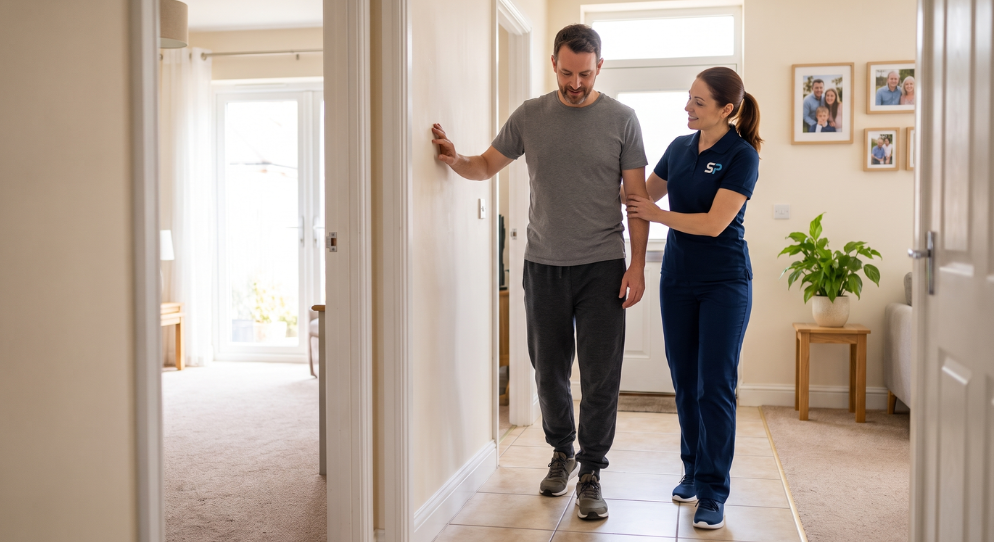
Home-based physiotherapy transforms the patient’s own environment into a rehabilitation setting. This allows treatment to focus on the specific challenges they face every day.
We work with the individual features of each home, such as:
- The step from the kitchen to the conservatory
- A narrow hallway
- A garden path with loose stones
Community-based sessions build on these skills by introducing real-world challenges. Patients practise walking in local shops, parks, and on public transport.
They can work on crossing roads at familiar junctions, navigating supermarket aisles, and managing the specific terrain found within their neighbourhood.
This approach ensures that improvements in walking after brain injury transfer directly into daily activities rather than remaining limited to a therapy environment.
Building Confidence Through Familiarity
Working in familiar environments helps build confidence alongside physical skills.
Patients often feel more secure practising challenging walking tasks in their own surroundings with support from their trusted physiotherapist. Family members can also see progress first-hand and learn how to provide appropriate assistance during everyday activities.
At SP Therapy Services, our specialist team recognises that successful gait re-education must prepare patients for their individual walking challenges.
By combining expert knowledge of the gait cycle with rehabilitation in homes and communities, we help people recovering from brain injury regain more than the ability to walk. We help them rebuild confidence and independence in their own world.
Specialist Physiotherapy for Walking After Brain Injury
SP Therapy Services provides specialist neurological physiotherapy for individuals recovering from brain injury.
Our experienced physiotherapists combine detailed gait analysis with practical rehabilitation strategies designed around each person’s goals, environment, and daily activities.
Whether someone is working on balance, mobility, confidence, or returning to community activities, our approach focuses on meaningful improvements that support everyday independence.
Ready to Start Your Rehabilitation Journey?
We provide home visits across Greater Manchester, Lancashire, West Yorkshire, and South Yorkshire.
Our specialist physiotherapists are based in:
If you or your client requires specialist support with walking after brain injury, our team can provide personalised neurological rehabilitation in the home and community.
Contact SP Therapy Services today to discuss your rehabilitation needs.
Are You a Case Manager Looking for a Physiotherapist to Join Your MDT?
Having been established for more than 27 years, SP Therapy Services is trusted by case managers and solicitors.
We pride ourselves on our clinical reputation for excellence while also having an in-depth understanding of the medicolegal landscape.
We provide timely three-monthly treatment plans, updates with SMART goals, and detailed costings to ensure you are consistently informed throughout rehabilitation.
If you are looking for an experienced neurological physiotherapy provider to support your multidisciplinary team, please contact SP Therapy Services.
All our specialists are registered with the Health & Care Professions Council and the Chartered Society of Physiotherapy.