Brain Injury Rehabilitation Goals for 2026: Why Your Home Matters Most
The start of a new year often brings renewed hope and determination to make positive changes. If you or a loved one is recovering from a brain injury across Greater Manchester, January 2026 might feel like the perfect time to set ambitious rehabilitation goals.
However, from my experience supporting families in Stalybridge, Ashton-under-Lyne, and throughout Tameside, the most meaningful progress often happens not in clinical settings, but in the unique therapeutic environment of your own home.
I’m Jacqueline, a Chartered Physiotherapist specialising in neurological rehabilitation, based in Stalybridge and working with brain injury survivors across Greater Manchester. What makes home-based physiotherapy so powerful isn’t just convenience. It’s that your home reveals challenges and opportunities for recovery that hospital or clinic settings simply cannot replicate.
When Brain Injury Effects Only Become Clear at Home
One pattern I see repeatedly, particularly with mild to moderate brain injuries, is that the real impact often only becomes clear once someone returns home and attempts to resume everyday life.
Hospital assessments may suggest good recovery. You can walk. You can dress yourself. Your speech is clear. Discharge summaries are optimistic.
Then you return home to your terraced house in Denton or your semi in Droylsden, and suddenly the problems emerge.
-
You can’t manage the shopping because supermarkets feel overwhelming
-
You struggle with meal preparation because sequencing steps feels impossible
-
You feel exhausted after simple daily tasks
-
Concentration disappears when there is background noise
-
The laughter of your grandchildren feels like nails on a blackboard
-
You experience dizziness and fatigue
-
Balance feels fine indoors but precarious on your uneven garden path
These are not signs of decline. They reveal the true functional impact of your brain injury — challenges that controlled clinical environments simply cannot expose.
Your home, with all its complexity and real-world demands, becomes the most accurate assessment tool we have, and the best treatment facility.
Neuroplasticity and the Power of the Home Environment
Neuroplasticity — the brain’s ability to heal and adapt after injury — is at the heart of all rehabilitation. But neuroplasticity does not happen in isolation.
The brain reorganises and forms new neural pathways based on:
-
The demands placed upon it
-
The environment in which it operates
This is why your home is such a powerful therapeutic environment. Every activity you perform — making breakfast, navigating your stairs, managing your bathroom routine — provides exactly the type of practice your brain needs to relearn real-world function.
When I work with families across Mossley, Dukinfield, or Hyde, I am not trying to replicate hospital therapy. I use your actual environment to challenge your brain in ways that directly translate to independence.
Uneven flooring, narrow hallways, awkward bathroom layouts, and the specific demands of your kitchen are not obstacles to avoid. They are therapeutic tools.
Your brain learns movement patterns best when practising them in context. Neuroplasticity is maximised when you solve real problems in real environments, rather than performing abstract exercises on gym mats.
Setting Meaningful Brain Injury Rehabilitation Goals for 2026
Goal-setting after a brain injury needs to be different from typical New Year’s resolutions. Generic goals such as “get stronger” or “improve balance” miss the point.
Meaningful brain injury rehabilitation goals are:
-
Specific
-
Functional
-
Directly connected to independence at home
Goals That Connect to Real Life
This is why I help people identify what genuinely matters to them. For example, you might want to:
-
Make a cup of tea independently without supervision
-
Walk to the local shops in the Stalybridge market area
-
Navigate your stairs safely without someone anxiously watching
-
Return to work in a Manchester city-centre office
-
Visit family in Stockport and play on the floor with your grandchildren
These are not just activities. They are markers of independence, dignity, and quality of life — and they must be practised and achieved in your real environment.
Assessment in Your Own Home Environment
When I assess someone in their Marple or Romiley home, I observe how they manage their actual spaces.
-
How do they manage their specific stairs?
-
What happens when they reach into their own kitchen cupboards?
-
Can they safely get in and out of their particular bath or shower?
This type of assessment reveals challenges that clinic-based testing often misses.
One gentleman I worked with in Bredbury had been discharged as “independent with mobility.” He walked well in the physiotherapy gym but required a frame outdoors. His Victorian terrace had steep, narrow stairs with a turn halfway up — stairs he could not manage safely.
He felt like a prisoner in his own home. That is the type of problem you only discover, and address, in someone’s real environment.
Using Your Home as a Therapeutic Tool
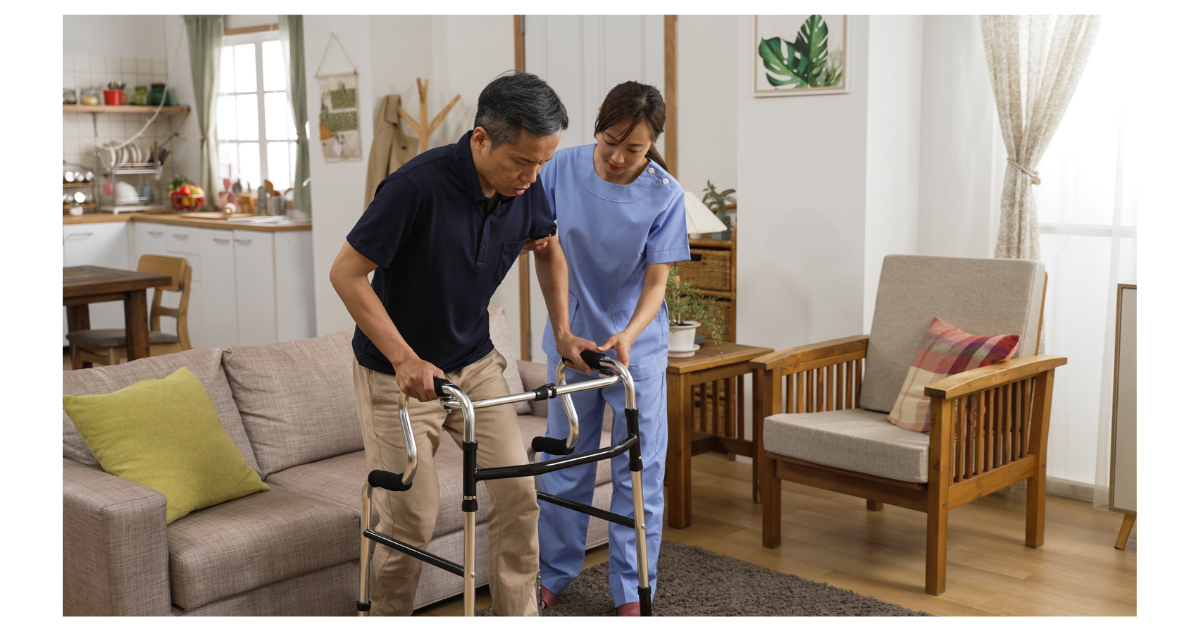
Your home becomes the therapy gym — but better than any gym, because every activity is meaningful.
We might use:
-
Your stairs for strengthening, balance, and cardiovascular conditioning
-
Your kitchen for sequencing, reaching, and dual-task training
-
Your garden for outdoor mobility, endurance, and uneven surfaces
-
Your furniture layout for obstacle navigation and spatial awareness
-
Your daily routines as structured practice opportunities
A lady I support in Hadfield wanted to return to gardening. Rather than generic balance exercises, we practised in her actual garden — negotiating uneven grass, bending to plant bulbs, carrying watering cans, and managing patio steps.
Her confidence grew week on week because her brain was learning the exact skills she needed, in the environment where she needed them.
That is neuroplasticity in action.
Building Progressive Challenge Into Rehabilitation
Neuroplasticity requires progressive challenge. The brain must be pushed just beyond its comfort zone — safely and purposefully — to form new pathways.
In your Greater Manchester home, progression can be perfectly calibrated:
-
We analyse confidence in standing and practise safely in your kitchen
-
You make a cup of tea with supervision and support
-
Homework consolidates the building blocks between visits
-
Standing tasks progress, confidence improves
-
Dual-tasking is introduced
-
Independence increases until the task becomes automatic
The goal is not simply to complete the task, but to complete it without consciously thinking about balance. That is when neuroplastic change has truly embedded.
Involving Family in Rehabilitation Goals
Family members often want to help but feel unsure how. Home physiotherapy provides a clear framework for involvement.
I support families by teaching them:
-
When to assist and when to step back
-
How to recognise fatigue and cognitive overload
-
How to support practice without “doing things for” their loved one
One family in Denton told me that understanding neuroplasticity completely changed their approach. Instead of saving their dad’s energy, they learned how to support him doing things himself — exactly what his brain needed.
Managing Expectations for Recovery in 2026
Brain injury recovery is not linear. Neuroplastic change takes time.
Some improvements happen quickly. Others emerge slowly over months or years. Some challenges require long-term management rather than full resolution.
This is not pessimistic — it is realistic.
I have worked with people across Glossop and the High Peak who made remarkable progress two or three years post-injury because they worked consistently on realistic goals and received strong family support.
Your Home, Your Recovery, Your 2026
Your Greater Manchester home is not just where you live. It may be the most powerful environment for your brain injury recovery.
Every room holds opportunities for neuroplastic change. Every daily activity provides practice that supports independence.
With expert guidance, consistent effort, and the therapeutic advantages of your own environment, 2026 can be a year of genuine progress.
Get Expert Support for Your Brain Injury Rehabilitation Goals
I’m Jacqueline, a Chartered Physiotherapist specialising in neurological rehabilitation, based in Stalybridge and working with brain injury survivors across Greater Manchester.
I provide expert home-based physiotherapy that uses your environment to support neuroplastic recovery and meaningful independence.
If you would like to discuss your 2026 brain injury rehabilitation goals, please contact SP Therapy Services to arrange an initial home assessment.
If you live outside my area, SP Therapy Services colleagues also work in Bury, Blackburn, Bradford, Holmfirth, and Barnsley.
📞 0161 764 3799
✉️ info@sptherapyservices.co.uk
About the Author
Jacqueline Boyle
Chartered Physiotherapist, Stalybridge
Professional Qualifications
-
BSc (Hons) Physiotherapy (2:1), Glasgow Caledonian University, 2005
-
Registered with the Health & Care Professions Council
-
Member of the Chartered Society of Physiotherapy
Read Jacqueline’s full profile here: