
If you’re a case manager working with a client who has support workers in their team, this is worth five minutes of your time.
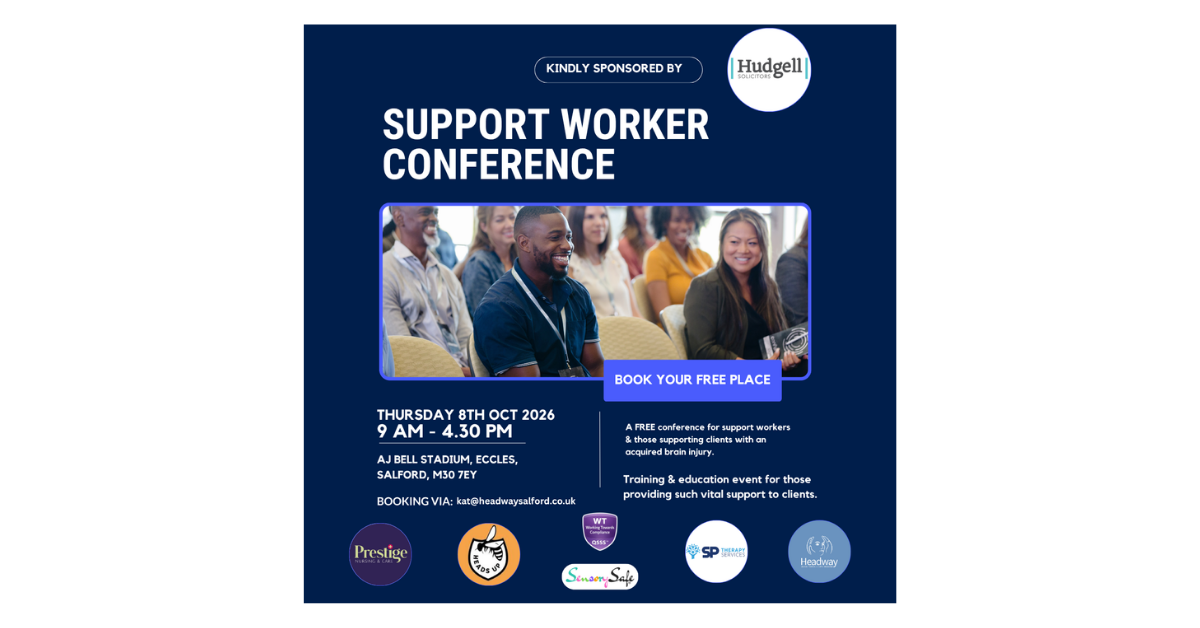
Bookings are open for the Support Worker Conference 2026, taking place Thursday 8th October at the AJ Bell Stadium. The full speaker programme is now confirmed. 180 free places are available.
If you missed it, you can read the full background to why we created this conference.
The short version is that support workers rarely get access to the paid professional development or MDT-wide understanding the rest of us take for granted. This conference is our attempt to change that.
Now that the full programme is confirmed, here’s what each session will actually cover.
The Confirmed Programme
Welcome: Why This Conference Matters — Matt Brown, Hudgells Solicitors
One Shift, Multiple Guidelines: The Everyday Challenge of Working in an MDT — the Support Worker’s Perspective — Daniel Bamber, Prestige Nursing Manchester
Balance, Falls and the Support Worker — Susan Pattison, Chartered Physiotherapist, SP Therapy Services
Leisure: An Occupational Therapy Goal — Ryan Price, Occupational Therapist, Heads Up Therapies
The Importance of Social and Cognitive Communication Skills in Conversational Speech — Catherine Davies, Speech & Language Therapist, SLT for Life
Working Together for Better Sleep: Sleep, Routines, Relationships and Real-Life Rehabilitation — Dr Penny Trayner, Paediatric Neuropsychologist, Clinical Neuropsychology Ltd
Borrowing Calm: The Power of the Support Worker–Client Relationship After Brain Injury — Dr Emma Weymouth, Psychologist, Newby Psychology
Your Role, Your Impact: Support Workers and Claims for Compensation — Matt Brown, Solicitor, Hudgells Solicitors
Money, Money, Money: Decisions, Decisions, Decisions — Ruth Wright, Financial Deputy, EMG Solicitors
Case Managers and the Support Worker — Louise Wolsey, Case Manager, Active Case Management
Why This Programme Matters for the Support Workers You Instruct
Look down that list and you’ll see it isn’t generic training. It’s built around the exact pressure points that show up in case management day to day:
- “One Shift, Multiple Guidelines” speaks directly to something every case manager will recognise: a support worker trying to reconcile handling advice, communication strategies, and routines from several therapists at once. Hearing this framed from the support worker’s own perspective is rare, and valuable.
- Balance and falls, sleep, and communication give support workers practical, immediately usable skills in the areas most likely to affect a client’s safety and daily functioning between MDT visits.
- The compensation and financial deputy sessions help support workers understand the wider legal and financial context their day-to-day care sits within. Often, this will be the first time they’ve had this explained directly, rather than inferred.
- “Case Managers and the Support Worker” closes the day by turning the lens back onto your own role, and what support workers most need from that relationship to do their job well.
We wrote recently about the physiotherapist’s role as an educator for both families and support teams. This conference is that same principle applied across the whole MDT, at scale, for one day.
What This Means for You
If you’re deciding whether to instruct your support workers to attend, the case is straightforward.
Better-informed support workers make for safer day-to-day care, more useful reporting back to you, and better retention. All at no cost to your client’s budget, since places and support worker pay are covered by sector-wide sponsorship, not billed to the case.
We’re asking providers to pay support workers for their time to attend, because if we want them to feel valued, their time needs to be treated as such.
Register your support workers:
Places are limited, so we’d encourage registering as early as possible.