
Written by Jane Raleigh, Chartered Physiotherapist, Holmfirth
A good falls plan can work so well that everyone forgets why it was there. Following October’s story of Lewis, we look at what happened when Simon, after a period without falls, finally needed his lifting aid and nobody felt sure how to use it, illustrating why falls prevention is an ongoing skill, not a one-off lesson.
Good progress after a stroke
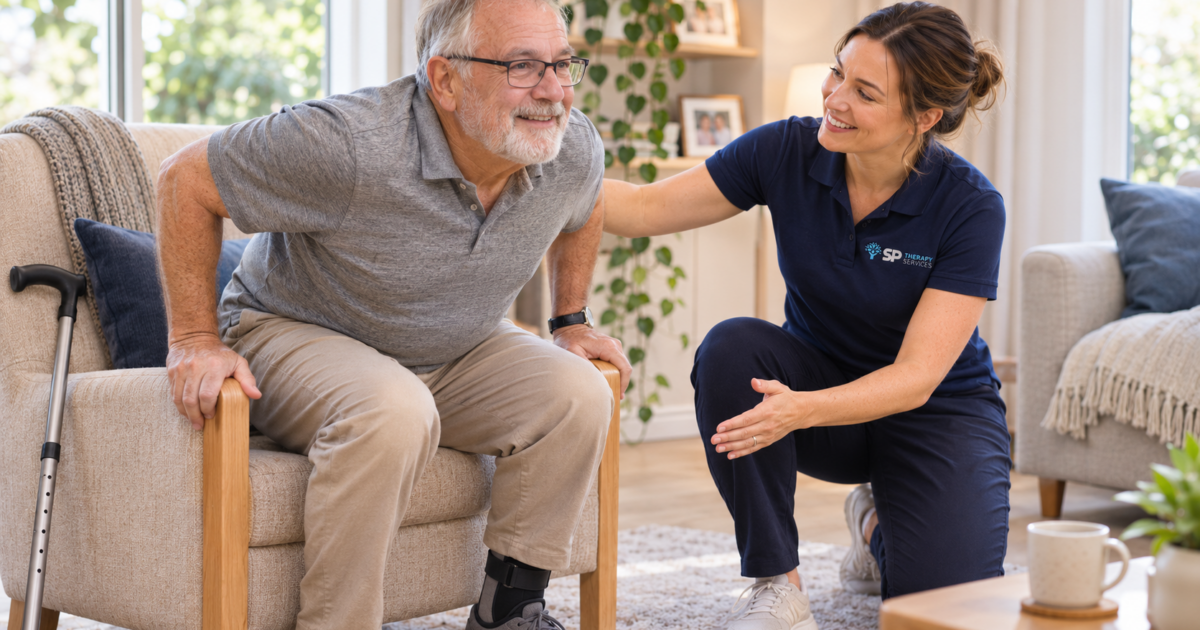
Simon, in his sixties, had a stroke that left him with weakness down one side of his body and difficulty with his balance. With hard work in his rehabilitation, he’d made great progress — walking more confidently around his home using a stick and a splint that supports his foot and ankle.
Early on, one risk was identified that needed monitoring: Simon didn’t wear his splint when asleep at night. If he woke and needed the bathroom in the dark, he’d be getting up without that support, and likely still a little sleepy, increasing the risk of falls.
Despite his progress, Simon was unable to get on and off the floor independently. An inflatable lifting aid was therefore put in place in case he ever found himself on the floor at home, and Simon and his family were trained to use it.
When a good plan fades into the background
But here’s the thing about a good plan that works well: over time, it can be easy to forget why it was needed in the first place.
Simon didn’t have any falls. He was getting on with life, walking more confidently around the house, and — quite rightly — he and his family stopped thinking about that night-time risk as something to actively manage. It simply wasn’t happening, so it faded into the background.
Meanwhile, Simon’s rehabilitation kept moving forward. He started doing more of the things he’d missed — including heading out to meet friends at the pub for a drink. This is a brilliant sign of progress. Getting back to real life, real friendships and real routines is exactly what rehabilitation was working towards.
The evening it was needed
One evening, Simon came home after an evening with friends. Getting up from his chair, he slipped and ended up on the floor. Simon was checked over and was unhurt: the only thing bruised was his pride, but despite Simon’s progress in his rehabilitation was still unable to get himself up from the floor.
Simon and his family had been taught how to use the inflatable lifting aid to help him up safely from the floor, should this ever happen. But because it had never actually been needed before, that knowledge hadn’t been kept fresh. In the moment, with everyone a little shaken, no one felt confident using the equipment safely. Quite rightly, the family made the safe choice not to physically lift Simon themselves, to protect their own backs and Simon’s safety. There were no neighbours close by to call on for extra hands.
So, Simon stayed on the floor, made as comfortable and warm as possible with pillows and a blanket, until another family member arrived to help him up safely. All in all, Simon spent 50 minutes on the floor. Fifty minutes is a long time to wait, even when you’re warm and comfortable.
Nothing about that evening was anyone’s fault. It’s simply what happens when a skill isn’t kept “topped up.”
In our next session, we revisited Simon’s falls plan and the family’s knowledge of Simon’s inflatable lifting aid. To be ready for use, it needs to stay permanently plugged in, and it was. The one detail the family had forgotten was that it must be unplugged to override the safety feature before it can be used. After a refresher and some calm conversations, the answer was not to restrict Simon’s visits to the pub, but to stay aware that the risk still existed.
Falls prevention is a skill, not a one-off lesson
Falls prevention only works if it’s treated as an ongoing skill — not a one-off lesson to tick off and file away. It’s not something we wait to act on until a fall has already happened, and it’s not something that stays fixed while everything else about a person’s life changes.
Think of it a bit like a fire drill, or the Scouts’ motto of “being prepared.” You don’t wait for the emergency to find out whether you remember what to do. You practise, every so often, precisely so that when a real situation happens, it feels familiar rather than frightening.
Going without a fall doesn’t mean the risk has gone away. It might just mean the plan is working, and it still needs to stay in place.
Progress brings new situations, not fewer risks. Getting back out into the world — pubs, friends, real life is wonderful and what community rehabilitation is all about.
Equipment and training are only useful if they’re kept fresh. Equipment that’s gathering dust in the hallway isn’t much help if nobody feels confident using it in the moment.
Build in a practice run
We’d encourage every family and support team in a similar situation to build in a regular “practice run” — a calm, unhurried moment to walk through what you’d do, together, long before you might ever need to.
Takeaways for case managers
- Review a client’s falls plan whenever their activity changes, such as returning to the pub, work or travel. Progress brings new situations.
- Check that equipment training has been refreshed with family and support workers at agreed intervals, not just at set-up.
- Make sure everyone knows the specific steps for using the equipment, including any safety features that must be overridden, and keep simple written instructions where they will be found.
- Check that the plan for a fall is realistic: who can attend, how quickly, and how the person is kept safe and comfortable while waiting.
Falls prevention and management should always be tailored to the individual and guided by their treating physiotherapist.
Would a falls plan review help one of your clients? Our Chartered Physiotherapists provide falls prevention and management at home and in the community, because moving with confidence matters and nobody should be frightened in their own home. We have home visit specialists in Blackburn, Bolton, Bradford, Bury, Barnsley, Holmfirth and Stalybridge, covering Greater Manchester, Lancashire, and South and West Yorkshire.
Call 0161 764 3799 or email info@sptherapyservices.co.uk.