Why SP Therapy Services are home visit specialists
Every case manager working with brain injury clients is, ultimately, trying to answer one question: how do we get the best possible outcome for this person? The answer is rarely a single intervention — it’s the sum of coordinated decisions across the care plan. One of the most significant of those decisions is where therapy actually happens. Home-based physiotherapy in care plans is increasingly the answer case managers are choosing, and the evidence from real client outcomes explains why.
At SP Therapy Services, we deliver neurological physiotherapy directly into clients’ homes and communities across Greater Manchester, Lancashire, and South and West Yorkshire. Here’s how this model fits into, and strengthens, a well-structured brain injury care plan.
Why Location of Treatment Affects Brain Injury Outcomes
Brain injury rehabilitation isn’t only about what exercises a client does — it’s about whether they can transfer those gains into real life. A client might walk confidently between parallel bars in a clinic gym, but freeze on their own staircase, on an uneven garden path, or in a crowded supermarket aisle.
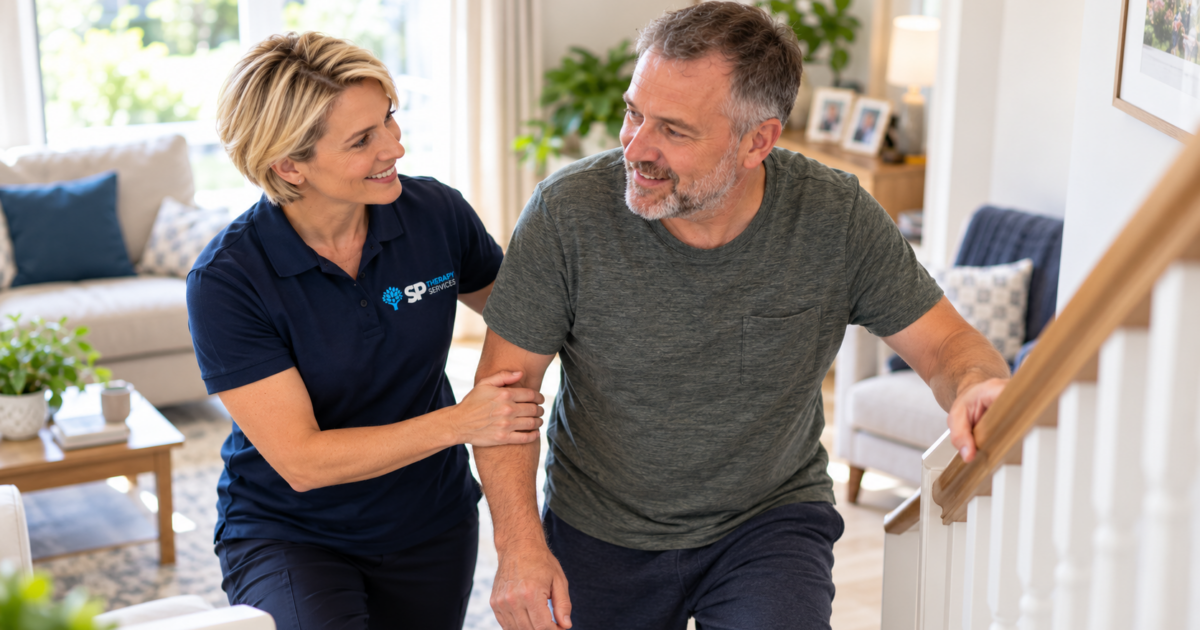
This is the core argument for home-based physiotherapy in care plans rehabilitation that happens in the actual environment the client lives in produces functional gains that translate directly to daily life. There’s no gap between “what works in the clinic” and “what works at home,” because the clinic and the home are the same place.
For clients with cognitive or perceptual difficulties following TBI, this matters even more. Familiar surroundings reduce anxiety and cognitive load, allowing the physiotherapy session to focus on motor and functional goals rather than on navigating an unfamiliar building first.
Building Home-Based Physiotherapy Into the Wider Care Plan
A strong brain injury care plan rarely involves physiotherapy in isolation. It sits alongside occupational therapy, speech and language therapy, psychology, case management oversight, and often family or paid support workers. Home-based delivery makes this coordination considerably easier.
Direct observation of the real environment. A home-based physiotherapist can flag practical risks — a loose stair carpet, a poorly positioned grab rail, a transfer that’s becoming unsafe — and feed that straight back into the MDT, rather than relying on a client’s account of their own home weeks after the last clinic visit.
Easier collaboration with other professionals. When an occupational therapist has recommended equipment or a home adaptation, the physiotherapist treating the client in that same space can immediately incorporate it into functional practice, closing the loop between recommendation and implementation.
More accurate reporting for case reviews. Outcomes recorded in the client’s actual living environment carry weight in funding reviews, MDT meetings, and medico-legal reporting, because they reflect genuine functional capacity rather than clinic-based performance.
Supporting Family and Carer Involvement
Brain injury recovery is rarely something a client manages alone. Family members and carers are often present for activities of daily living long after formal therapy sessions end. Home-based physiotherapy allows therapists to coach families directly — showing them how to support a safe transfer, encourage practised exercises, or recognise signs of fatigue — in the setting where that knowledge will actually be used.
This kind of practical carer education is difficult to replicate in a clinic appointment, and it’s one of the most consistent pieces of feedback we receive from the families we support.
Translating practice into the wider community Our role doesn’t stop at the front door, we work with the client and family to translate these skills outside of the home and support integration back into their community, transfers into cars, walking to the shops or support for joining a local gym.
What This Means for Case Managers Building a Plan
When you’re scoping physiotherapy provision for a brain injury client, home-based delivery offers several practical advantages worth weighing into the plan:
– Reduced travel burden and fatigue for clients already managing limited energy
– Functional, environment-specific goal setting from the first session
– Closer alignment with OT, family, and carer input
– Stronger, more defensible outcome reporting for case reviews
– Flexibility to adapt sessions around appointments, school runs, or fluctuating presentation
Partnering With SP Therapy Services
We deliver specialist home and community-based neurological physiotherapy across Bury, Bolton, Bradford, Holmfirth, Blackburn, Stalybridge, Barnsley, and the wider surrounding areas. Every client is supported by a Chartered Physiotherapist with neurological training, working to SMART goals and reporting on a structured, transparent basis that fits straight into your case management documentation.
If you’re putting together an Immediate Needs Assessment or a care plan and want to discuss how home-based physiotherapy could fit in, please get in touch by calling Emma Hayden on call 0161 764 3799. We’re happy to talk through a specific case before any referral is made.