The Physiotherapy Role in Community Reintegration
When case managers develop long-term plans for brain injury community rehabilitation across Greater Manchester, medical stability and home safety come first.
However, once your client is safe at home, the next step becomes essential: community reintegration.
This stage of recovery is not a luxury. It is a core part of brain injury community rehabilitation, supporting independence, wellbeing, and long-term outcomes.
I’m Susan Pattison, Director and Chartered Physiotherapist at SP Therapy Services in Bury.
After 27 years supporting people across Greater Manchester, I’ve seen how physiotherapy plays a vital role in brain injury community rehabilitation.
Case managers who understand this can plan more effectively, set realistic timelines, and support meaningful progress beyond the home.
What Is Brain Injury Community Rehabilitation?
Brain injury community rehabilitation means different things to different people.
- In Bolton, it may mean returning to work
- In Salford, it could mean independent shopping
- In Rochdale, it might involve social or religious activities
- In Manchester, it could include returning to education
Despite these differences, the goal is the same. It is about moving beyond the home into real-world environments.
These environments increase physical demands, cognitive load, and social interaction.
Your client must:
- Navigate unfamiliar spaces
- Manage sensory input
- Interact socially
- Maintain safety awareness
- Build endurance
As a result, someone who functions well at home may struggle outside.
The home is predictable. The community is not.
That is why physiotherapy for brain injury community rehabilitation differs from home-based rehabilitation.
The Role of Physiotherapy in Community Reintegration After Brain Injury
Physiotherapy supports recovery far beyond basic mobility. It plays a key role in helping clients function in real environments.
Outdoor Mobility Training
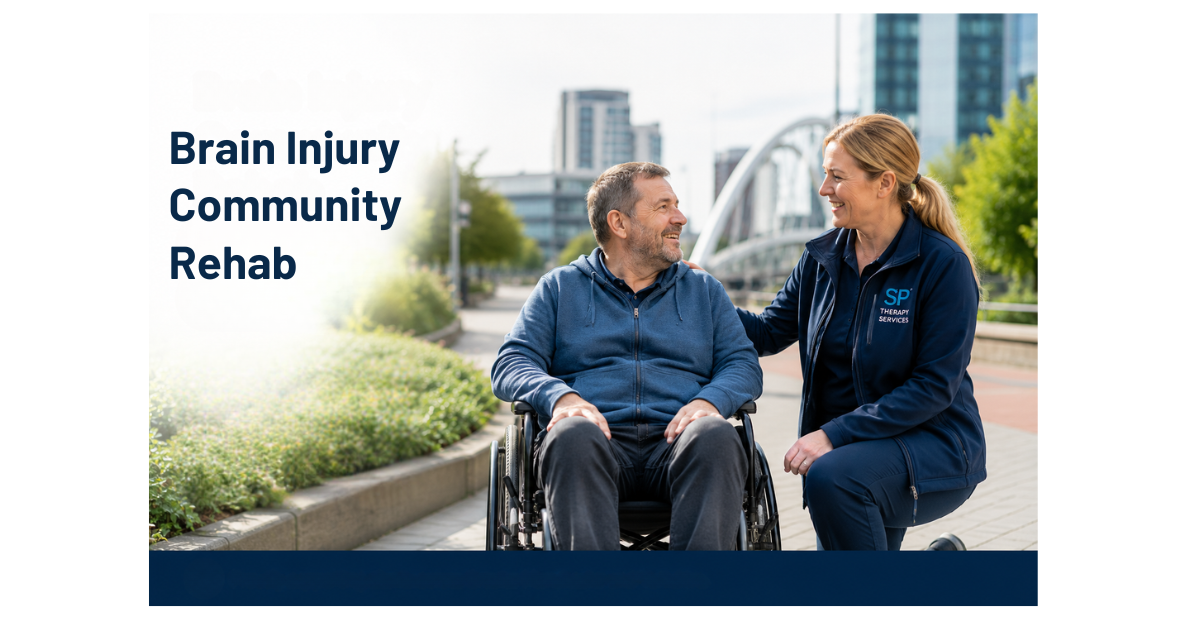
Outdoor mobility is a key step in brain injury community rehabilitation.
Clients must manage uneven pavements, curbs, crossings, and longer distances.
I assess clients in real environments across Greater Manchester, including Bury, Prestwich, and Whitefield.
This highlights challenges such as:
- Balance problems
- Visual processing difficulties
- Reduced endurance
- Anxiety outdoors
We then build skills gradually. For example, we increase walking distance, practise uneven surfaces, and improve road safety awareness.
A client in Radcliffe needed four months of outdoor training. He walked well at home but felt overwhelmed outside.
With structured support, he progressed to walking independently to local shops.
Public Transport and Community Access
Public transport is often essential for independence. However, it presents both physical and cognitive challenges.
These include boarding safely, maintaining balance, planning routes, and coping with busy environments.
Physiotherapy helps by building confidence through practice and teaching simple strategies.
For example, a client in Oldham regained confidence using buses and returned to college within weeks.
Shopping and Everyday Activities
Shopping is a common goal in brain injury community rehabilitation.
It involves navigation, decision-making, and physical endurance in busy environments.
Many clients struggle with this, even if they manage well at home.
Physiotherapy supports progress through gradual exposure, safe carrying techniques, and fatigue management.
Social and Leisure Participation
Rehabilitation is not just about tasks. It is also about quality of life.
This includes socialising, hobbies, exercise, and cultural or religious activities.
Each activity has different physical demands.
For example, returning to a choir may require standing endurance, stair use, and postural control.
With the right support, clients can return to meaningful activities that improve wellbeing and identity.
Vocational Rehabilitation
Returning to work is often a key goal.
Physiotherapy supports this by improving commuting ability, physical tolerance, and fatigue management.
A client in Salford successfully returned to work after structured preparation and a gradual increase in hours.
When to Start Community Rehabilitation After Brain Injury
Timing is important. Starting too early can overwhelm the client, while delays can slow progress.
Signs Your Client Is Ready
Your client may be ready when:
- They are physically stable at home
- Cognitive challenges are understood
- They want to increase activity
- Family support is available
- Medical issues are stable
Every case is different, so avoid fixed timelines.
A Gradual Approach
Rehabilitation in the community should follow a structured progression:
- Home surroundings
- Local neighbourhood
- Supported outings
- Reduced support
- Independent access
This approach builds confidence and reduces risk.
Common Challenges in Community Rehabilitation
Anxiety
Fear can limit progress. Gradual exposure helps build confidence over time.
Fatigue
Community activity is demanding. Pacing and energy management are essential.
Environment
Weather and surroundings across Greater Manchester can affect mobility and access.
Family Support
Families need guidance to balance safety with independence.
Long-Term Community Rehabilitation and Independence
Brain injury community rehabilitation does not end after discharge.
Some people remain independent, while others benefit from occasional support.
Ongoing physiotherapy can help maintain progress and prevent setbacks.
Get Expert Support
I’m Susan Pattison, Director and Chartered Physiotherapist at SP Therapy Services.
I specialise in brain injury community rehabilitation across Greater Manchester.
If your client is ready to progress beyond home-based rehab, I’m happy to help.
Contact SP Therapy Services to support safe and meaningful community participation.
Because recovery does not end at home. It continues in the community, where independence and quality of life are rebuilt.
About the Author
Susan Pattison is a chartered physiotherapist specialising in neurological rehabilitation. Provides evidence-based neurophysiotherapy through home visits. Passionate about harnessing neuroplasticity to help people regain movement and improve quality of life after neurological events.
About SP Therapy Services
We provide home-based brain injury physiotherapy across Greater Manchester, Lancashire, and South and West Yorkshire.
Our team includes specialists based in:
Bury, Bolton, Blackburn, Stalybridge, Bradford, Holmfirth and Barnsley.