
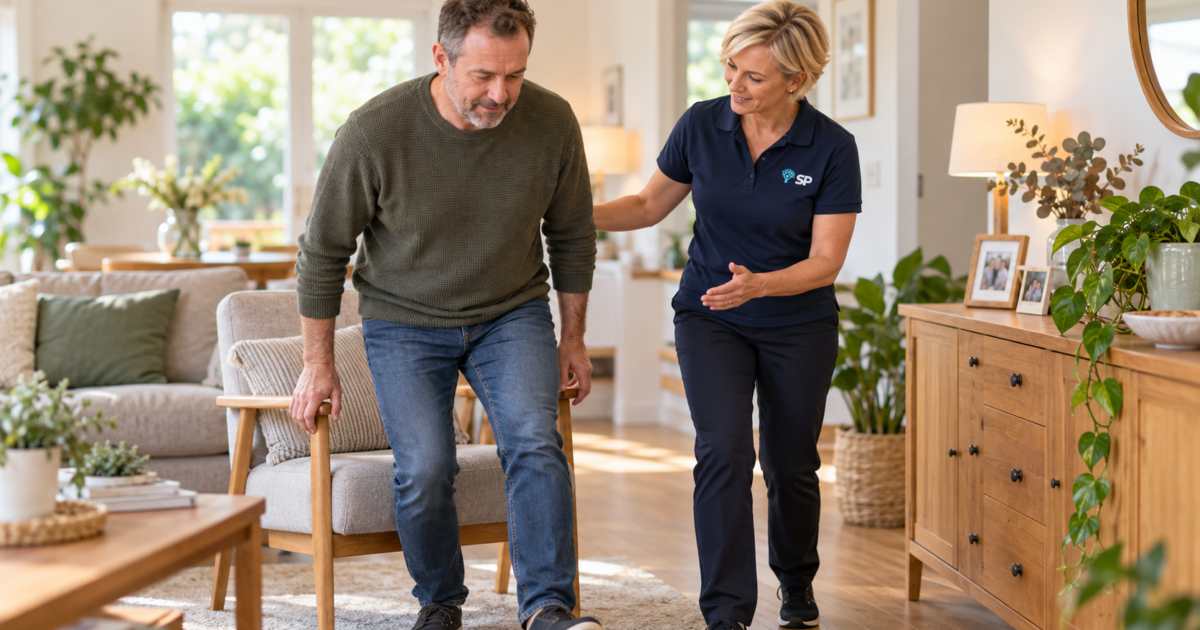
Rehabilitation is a risky business. We tend to think as a client progresses the falls risk reduces, but as their worlds expands the challenges of the everyday life present greater demands on their balance. For clients living with brain injury, the risk of falling isn’t a peripheral concern – it needs to sit at the centre of the rehabilitation plan.
Why brain injury clients carry a different level of falls risk
We tend to associate falls risk with older more frail adults, but it is a prevalent risk in brain injury and it is compounded by several factors specific to brain injury:
Impaired balance control – good balance is complex and required the integration of visual, vestibular, proprioceptive and motor systems to react effortless to changing circumstances to keep you upright. Brain injury impacts on the speed in which these areas of the brain communicate, making responses slower. The thing about good balance is you only know you have it when you lose it and then regain it! Slow responses are not effective, and the consequence of poor balance is a fall.
Cognitive overload – good balance is unconscious and automatic;it enables us to dual task for example walk and talk. Poor balance makes movement conscious and demands valuable cognitive broadband width, which a client with cognitive issues just doesn’t have and this contributes to fatigue.
Fatigue – results in fluctuating falls risk, a client’s falls risk can change from day to day or day to night or from one environment to another depending on the demands put on their balance systems.
Lack of insight — many clients experience reduced awareness of risk, impulsivity, that mean a client may not recognise a hazard until it’s too late
Risk can’t be avoided — it has to be managed
If a client has a balance problem, they have a falls risk. There’s no way around this, because balance is only maintained and improved by being challenged. Rehabilitation is, by its nature, a risky business. We can’t eliminate that risk by avoiding it — the only responsible option is to acknowledge it and manage it proactively.
This matters because real progress happens in real environments. Engaging clients in community activities — the local allotment, the weekly shop, visiting friends and family — means asking them to adapt to a changing, unpredictable environment. That’s exactly the challenge that drives genuine functional improvement. It’s also exactly where risk lives.
Risk management is about balancing severity with probability. Good risk management is about being aware of the potential risks associated with a particular activity and putting measures in place to enable the activity to be completed safely. The fact a client fall not fallen, does not negate the risk.
Nobody wants a client to fall, in the same way nobody wants a plane to crash. But we don’t respond to that risk by grounding every flight — we respond with a safety briefing, a trained crew, and a plan for what happens if something goes wrong. Rehabilitation needs the same mindset. Not acknowledging the risk doesn’t protect anyone; it leaves both the client and their support workers exposed, with no plan to fall back on if something does happen.
Where the only instruction given to support staff is to call an ambulance, it’s worth asking honestly whether that holds up in practice — for a client who’s gone down in a rainy car park at dusk, outside the cinema, when ambulance response times can run into hours.It’s not just the fall itself that carries risk. The longer someone is on the floor before help arrives — clinically referred to as a “long lie” — the greater the risk of secondary complications: dehydration, and hypothermia. A long lie is also strongly associated with a loss of confidence and an increased likelihood of hospital admission, independent of any injury sustained in the fall itself. This is exactly why the time between a fall and a response matters as much as preventing the fall in the first place.
This is why assessment has to cover more than prevention. It needs to answer: can this client get up off the floor? Where the answer is yes, floor-based exercises built into treatment sessions and the home exercise programme give both the client and their support workers a practised, confident strategy for the moment it’s needed. Where the answer is no, the plan should still cover what assistance is required and how it’s delivered — practised in advance, so that if a fall does happen, the response is to minimises injury to the client and the support workers rather than improvising in the moment. Identifying portable equipment that can be kept in a car boot — rather than only ever available at home — gives the support team real options and choices, instead of a single fallback of waiting for emergency services.
What a robust falls risk assessment and management plan actually involves
A proper assessment goes beyond identifying that a client is at risk — it identifies why, in terms specific enough to act on, this typically includes:
Clinical assessment of the contributing factors — balance, strength, sensation, cognition, and how these interact for that specific client and condition
Environmental assessment — the home, equipment, and any community settings the client moves through regularly
A written management plan that translates findings into practical strategies: equipment recommendations, exercise programmes, environmental adjustments, and clear guidance for anyone supporting the client day to day
Effective practice – a well-rehearsed drill in the same way we rehearse CPR or how to manage epilepsy
Reassessment points, particularly important for fluctuating conditions, so the plan evolves rather than becoming a static document filed away after the initial visit
Striking the balance right
There’s a balance to strike here.
It is reA support team that’s clearly briefed on a client’s falls risk is essential — but a team that visibly changes its behaviour around a client, hovering, over-cueing, or letting its own anxiety show, can do almost as much harm as an uninformed one. Clients are often acutely sensitive to a shift in how they’re supported, and a team that suddenly seems nervous can trigger the very fear-of-falling cycle, without the word being said. The goal of a good management plan isn’t just what the team does — it’s how normally they’re able to do it: confident, consistent support that manages risk without broadcasting it.
The cost of getting this wrong
A fall that results in injury can mean a hospital admission, a regression in mobility gains that took months to build, and — for clients already managing complex rehabilitation needs — a real setback to confidence and independence.
For case managers, an unaddressed falls risk that later results in an incident also raises difficult questions: was the risk identified, was it acted on, and was the support team properly informed?
A clear, client-specific falls risk assessment and management plan, reviewed regularly and shared with the full support team, is the most direct way to answer those questions before they need to be asked.
If you’re a case manager looking to put a falls risk assessment and management plan in place for a client, get in touch with our team to discuss how we can support your client and their wider support network.